SYMPHONY
a planisphere of the neuromimetic code substrate
· nervous system for software ·
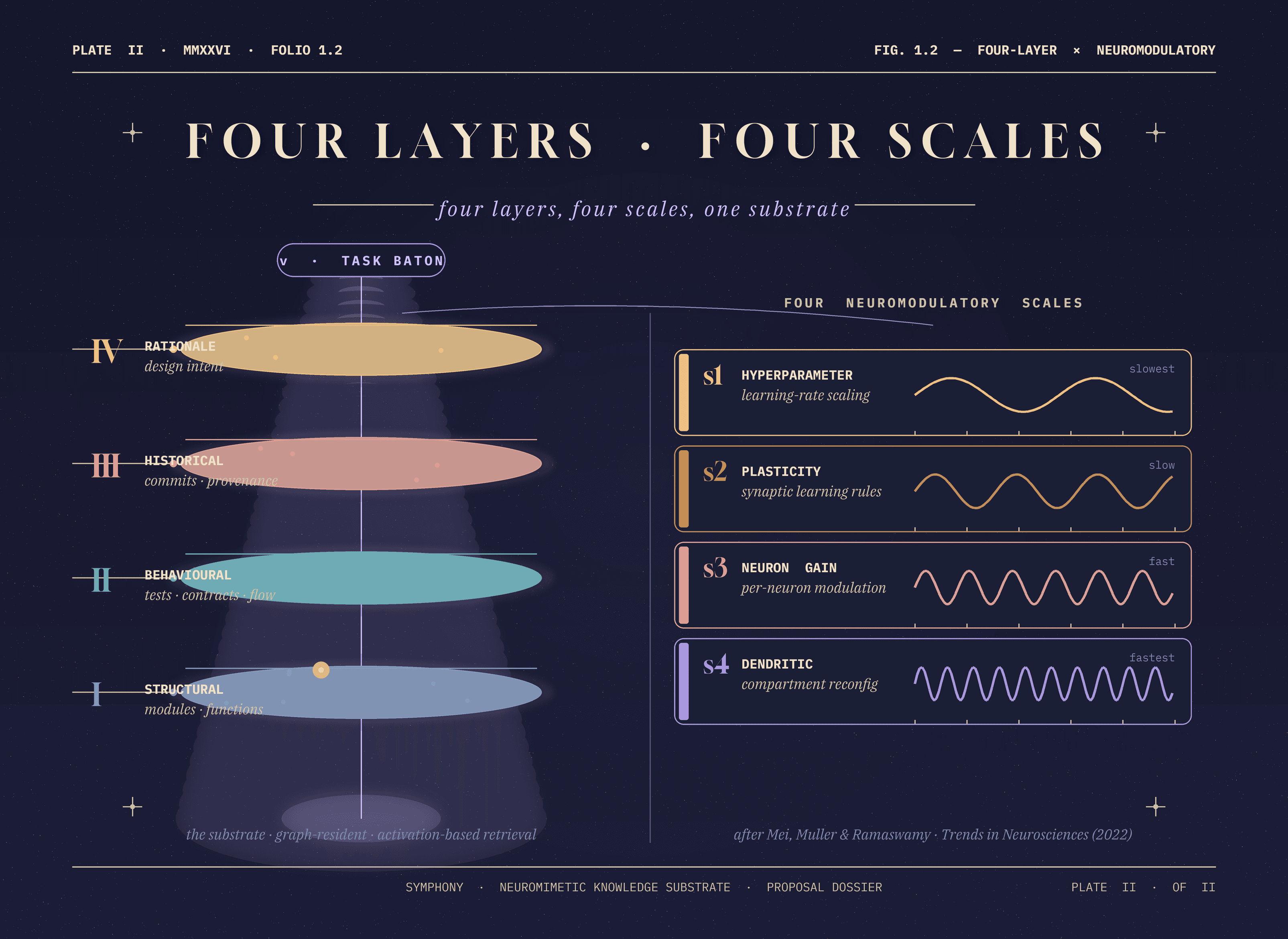
design intent
commits · provenance
tests · contracts · flow
modules · functions
LOCALISATION
Pinpoint the source of an observed bug or behaviour.
Rationale & Behavioural up · Structural narrowed
Implement the four-scale framework of Mei, Muller & Ramaswamy (2022): hyperparameter, plasticity, neuron-level and dendritic modulation, adapted to symbolic activations. F1 ≥ 0.6 against expert ground-truth, M18.
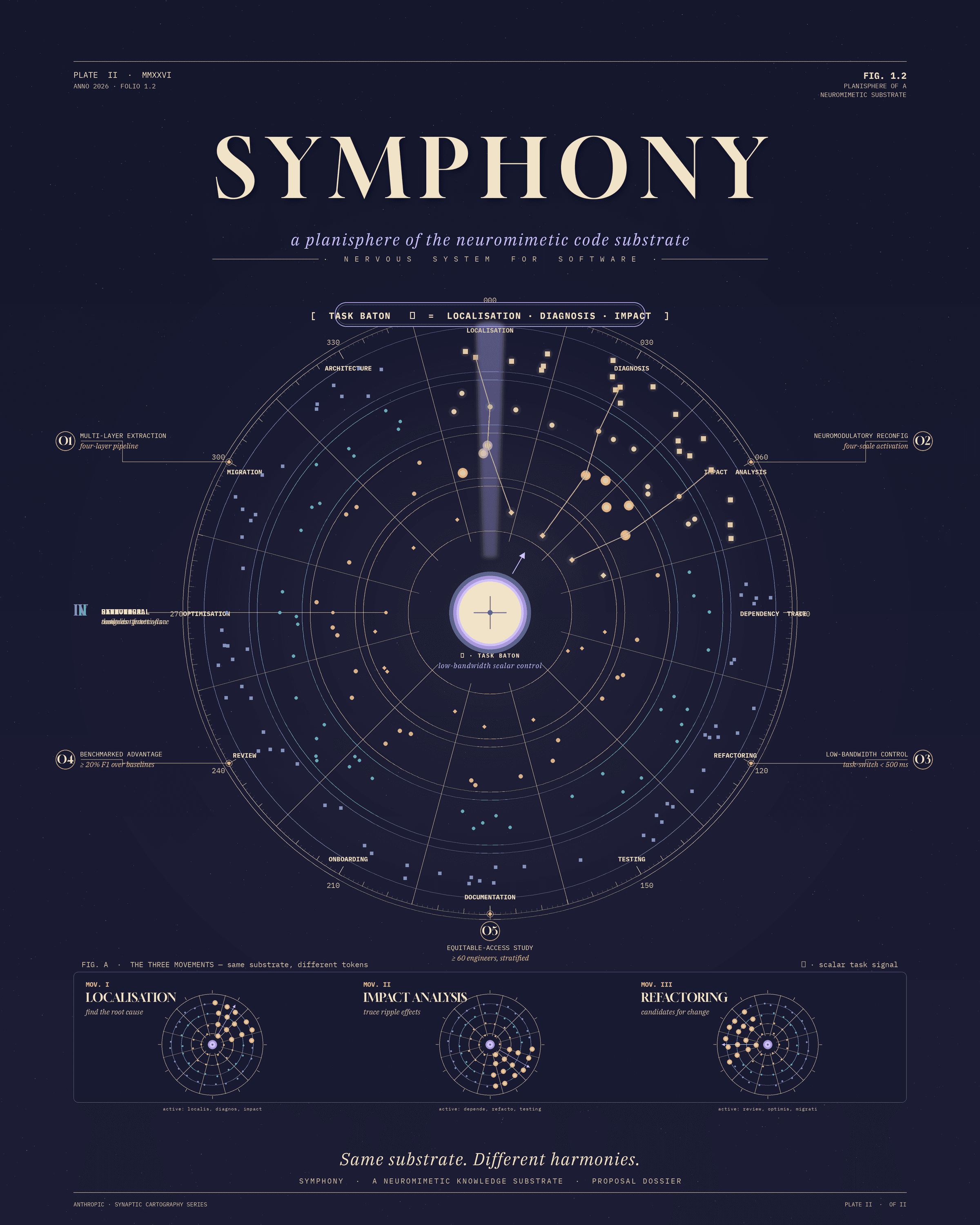
SYMPHONY will establish the first neuromimetic knowledge substrate for software systems: a computational representation of code in which the elements of a software system, modules, functions, data flows, contracts, tests, commit history, design decisions, are encoded as nodes in a multi-scale network whose activation patterns are reconfigured, on demand, by task-specific neuromodulatory signals.
In plain terms, a code representation that behaves less like a document to be re-read and more like a nervous system that foregrounds the structures relevant to the engineer’s current task.
Plate I · Panoramic vision
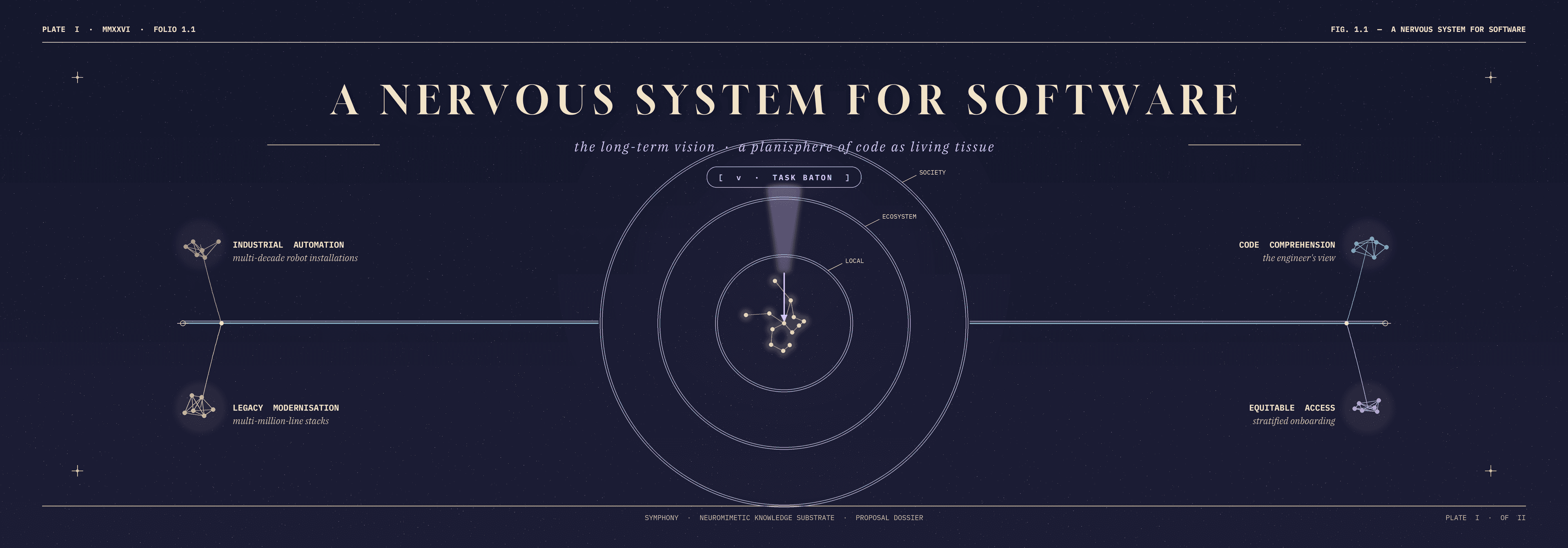
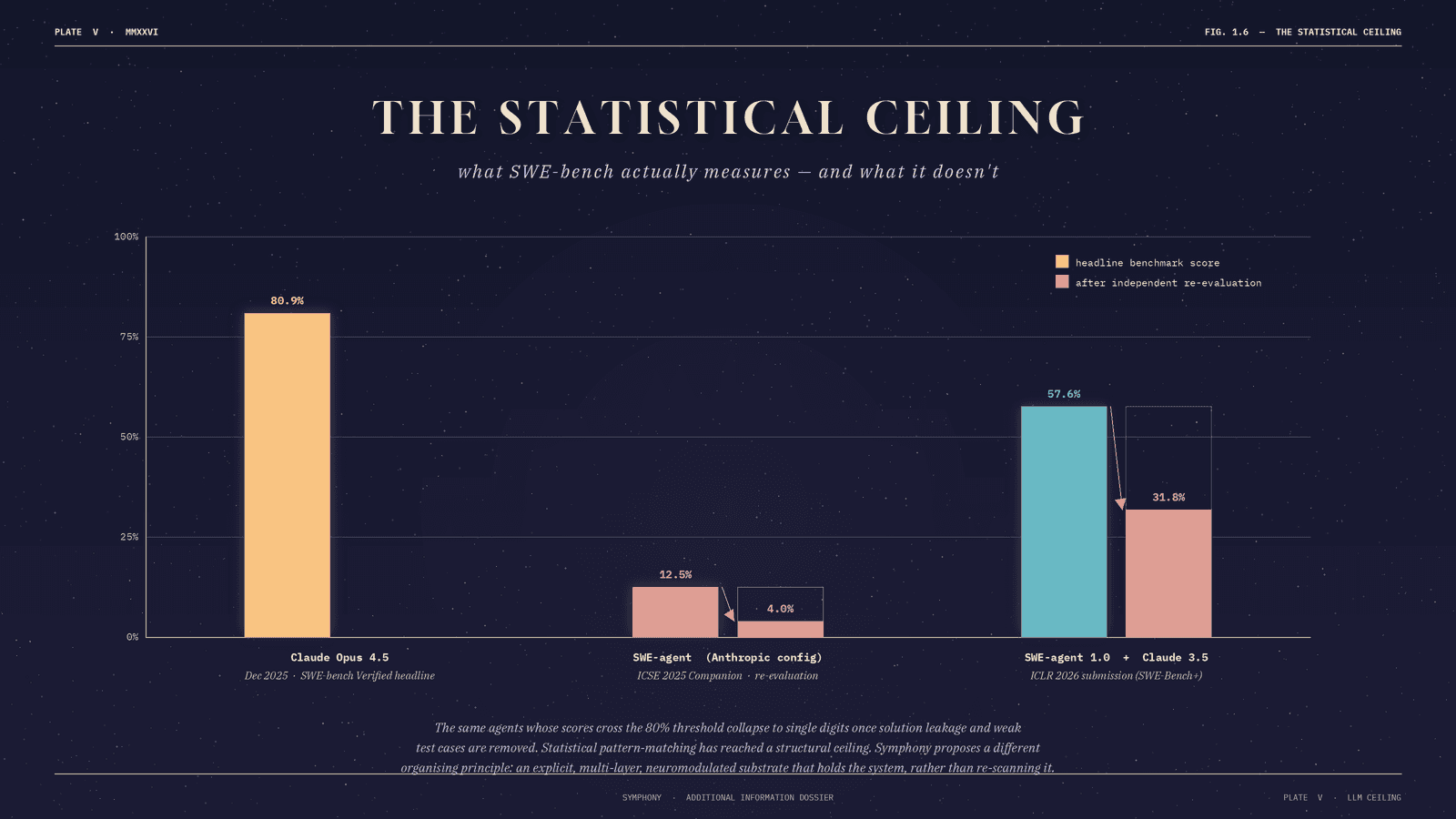
Current approaches to machine code understanding divide into two families, each with a structural ceiling we expect to hit within this decade. The first is statistical, large-language-model agents whose headline benchmark performance does not survive independent re-evaluation. The second is structural, call graphs, dependency edges, architecture knowledge graphs, which capture what is explicitly declared but not the design rationale that governs software change.
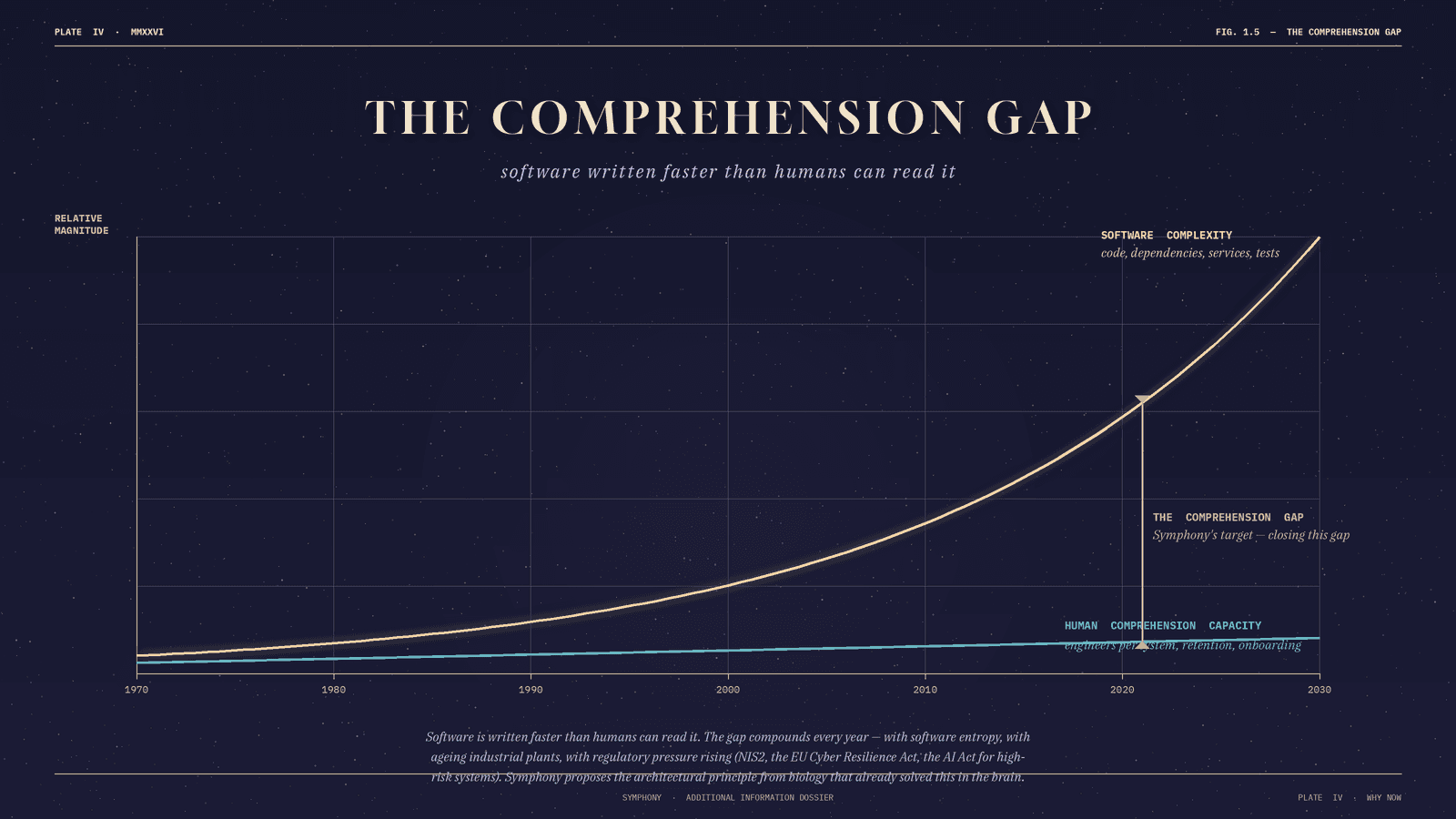
SYMPHONY’s advance is not to improve either family but to combine their information content under an organising principle drawn from biology. The two charts below anchor the ceiling argument; the substrate figure that follows shows what we propose to build in its place.
Published SWE-bench Verified scores against independent re-evaluation. Independent ICSE 2025 Companion and ICLR 2026 replication studies both find a headline collapse once solution leakage and weak test cases are removed.
Software-system complexity against individual human comprehension capacity, 1970–2030. The widening gap is the problem the substrate is built to address, through task-adaptive activation, not exhaustive re-reading.
Multi-layer extraction
Existing architecture-recovery pipelines produce either a single view or a separate document corpus. SYMPHONY unifies structural, behavioural, historical and rationale layers in a single graph-resident representation, built for activation-based retrieval rather than query-based retrieval.
Context-dependent activation
No existing representation alters its own salience profile in response to the engineer’s declared task. SYMPHONY’s substrate maintains a single state of the system but surfaces different subnetworks under a task token, using the four-scale neuromodulatory primitives of Mei, Muller & Ramaswamy (2022) as the mathematical template.
Low-bandwidth task control
Borrowing from Siciliano’s haptic shared-control architecture, the task interface is intentionally narrow, a small set of scalar modulatory signals, not a prompt window, so that behaviour under different engineering tasks is composable, auditable, and bounded.
At TRL 1–4 the question is whether the mechanism is sound, not whether an industrial artefact exists. Three converging lines of published evidence support the mechanism.
Mei, Muller & Ramaswamy (Trends in Neurosciences, 2022), neuromodulatory units at four scales yield faster adaptation, higher cumulative reward and resistance to catastrophic forgetting in deep networks.
Selvaggio, Pacchierotti, Giordano & Siciliano (RA-L 2018; ICRA 2019; T-RO 2022; RAS 2025), low-bandwidth supervisory signals reshape high-DOF autonomous controllers into qualitatively distinct task behaviours.
SWE-bench re-evaluations show 80 %+ headline scores collapse to single digits or 30 % once leakage is removed, incremental scaling does not close the comprehension gap.
Each objective carries a quantitative threshold, a decision milestone, and a documented alternative path if the threshold is missed. RP1 closes at M12; RP2 closes at M36.
| No. | Objective | Threshold | Milestone | Lead |
|---|---|---|---|---|
| O1 | Multi-layer extraction pipeline | ≥ 90 % function coverage, ≥ 80 % inter-module dependencies on both demonstrator codebases | M12 | Real AI · UP Robotics |
| O2 | Neuromodulatory reconfiguration mechanism | F1 ≥ 0.6 vs expert annotation, p < 0.01 paired across ≥ 30 instances and ≥ 3 task classes | M18 | Newcastle · Real AI |
| O3 | Low-bandwidth task control interface | Task-switching latency < 500 ms; state-preservation ≥ 0.95 over ≥ 100 trials | M24 | CREATE-PRISMA · Newcastle |
| O4 | Benchmarked advantage over LLM and KG baselines | ≥ 20 % relative F1 lift on task-relevant-subgraph recovery; ≥ 15 % in expert-rated actionability | M30 | Real AI · external advisory |
| O5 | Equitable-access user study (≥ 60 engineers) | Significant reduction in time-to-first-correct-change for under-represented strata, non-inferior 30-day retention | M33 | Newcastle ethics · Real AI |
Four partners across three EU member states pair complementary expertise: cortical neuromodulation from Newcastle (Ramaswamy); haptic shared control from CREATE-PRISMA / UNINA (Siciliano); foundation models for the real world from Real AI; and an industrial-automation demonstrator codebase from UP Robotics. Each lead carries a published, decade-spanning record in the slice of the work they own.
Plate III · Consortium
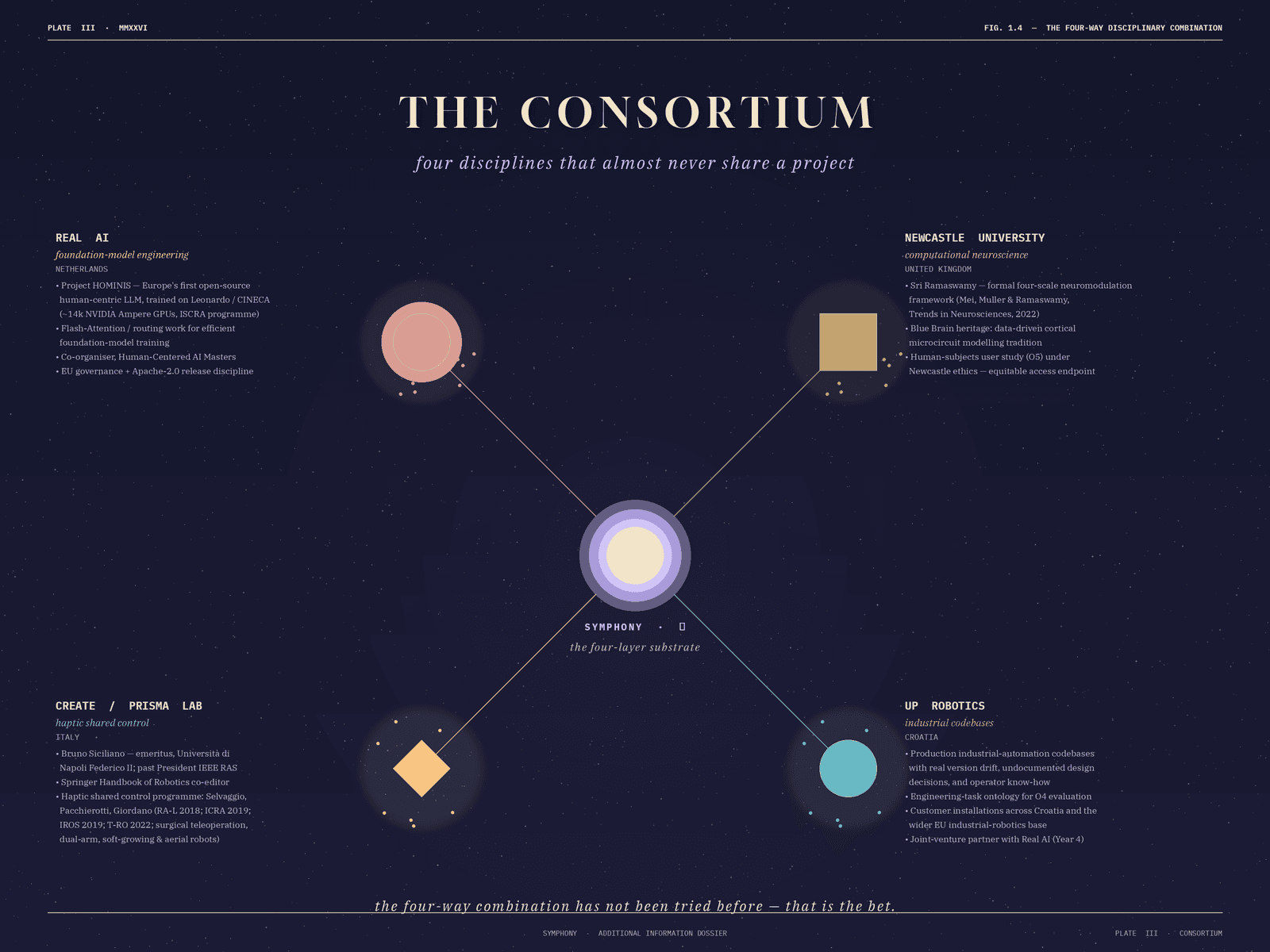
Plate VII · Ramaswamy / Blue Brain
Sri Ramaswamy
Chair of computational neuroscience at Newcastle’s School of Computing. Third author of Mei, Muller & Ramaswamy (Trends in Neurosciences, 2022), the four-scale neuromodulatory framework that SYMPHONY transposes from continuous perceptual signals into the discrete symbolic domain of source code. A Blue Brain Project alumnus whose pedigree spans cortical microcircuit reconstruction from 2005 to today.
Newcastle leads O2, the implementation of the four-scale neuromodulatory mechanism on the substrate produced by O1, and co-leads the ethics layer of O5.
Read Sri Ramaswamy’s full page →Bruno Siciliano
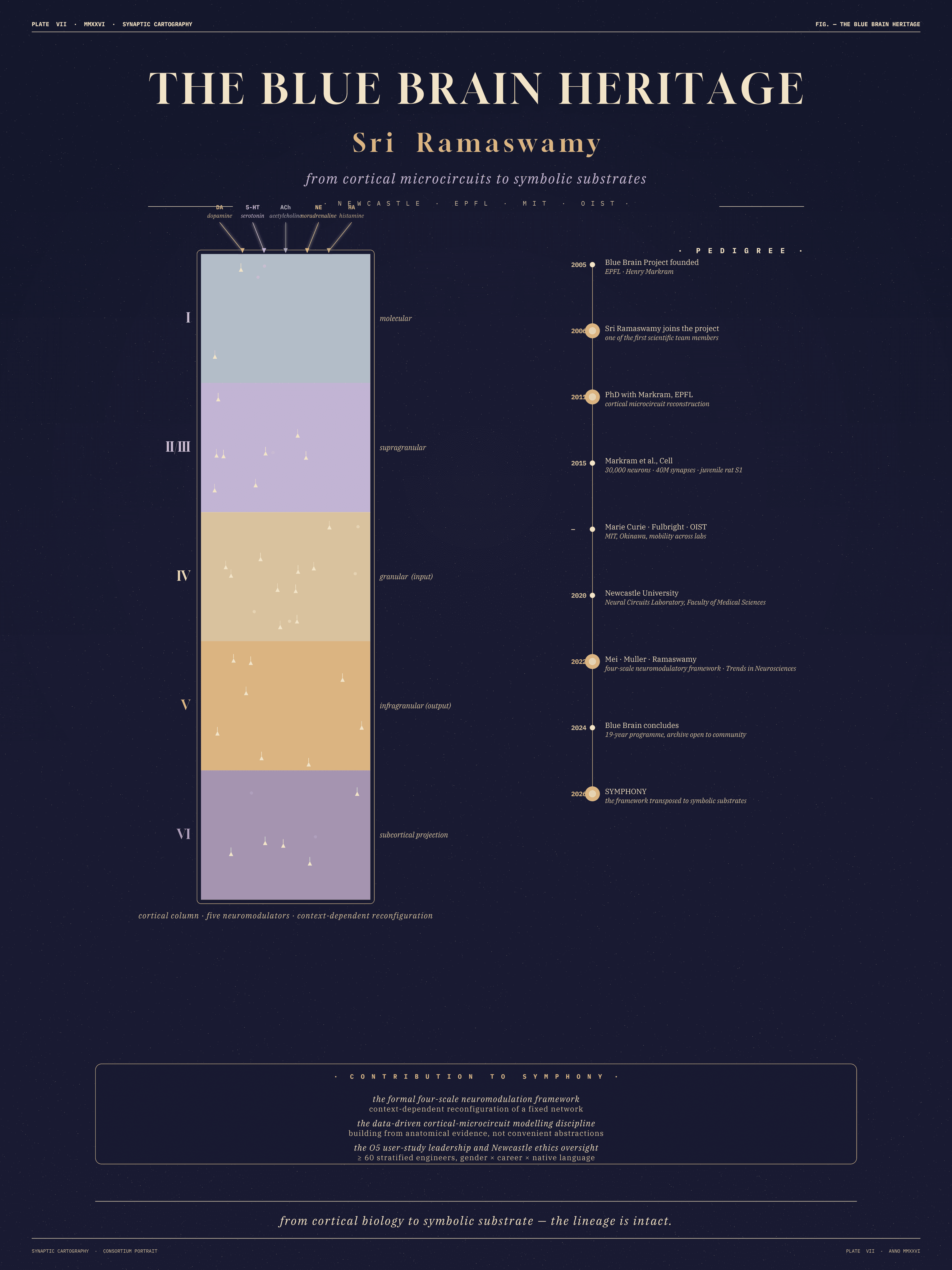
Director of the PRISMA Lab, Projects of Industrial and Service Manipulation Robotics, at CREATE / UNINA in Naples. ERC Advanced Grant holder and Engelberger Award laureate. The Siciliano-school programme on haptic shared control demonstrated, in hardware, that a low-bandwidth descending signal can reshape a high-DOF autonomous controller’s operating regime without rewriting it, the architectural property SYMPHONY transposes from physical manipulation into the symbolic control of a code substrate.
CREATE-PRISMA leads O3, the derivation of a narrow scalar control interface by which task tokens reshape the substrate’s activation regime without modifying its stored structure.
Keep the gradient.
Read Bruno Siciliano’s full page →Plate VIII · Siciliano / PRISMA
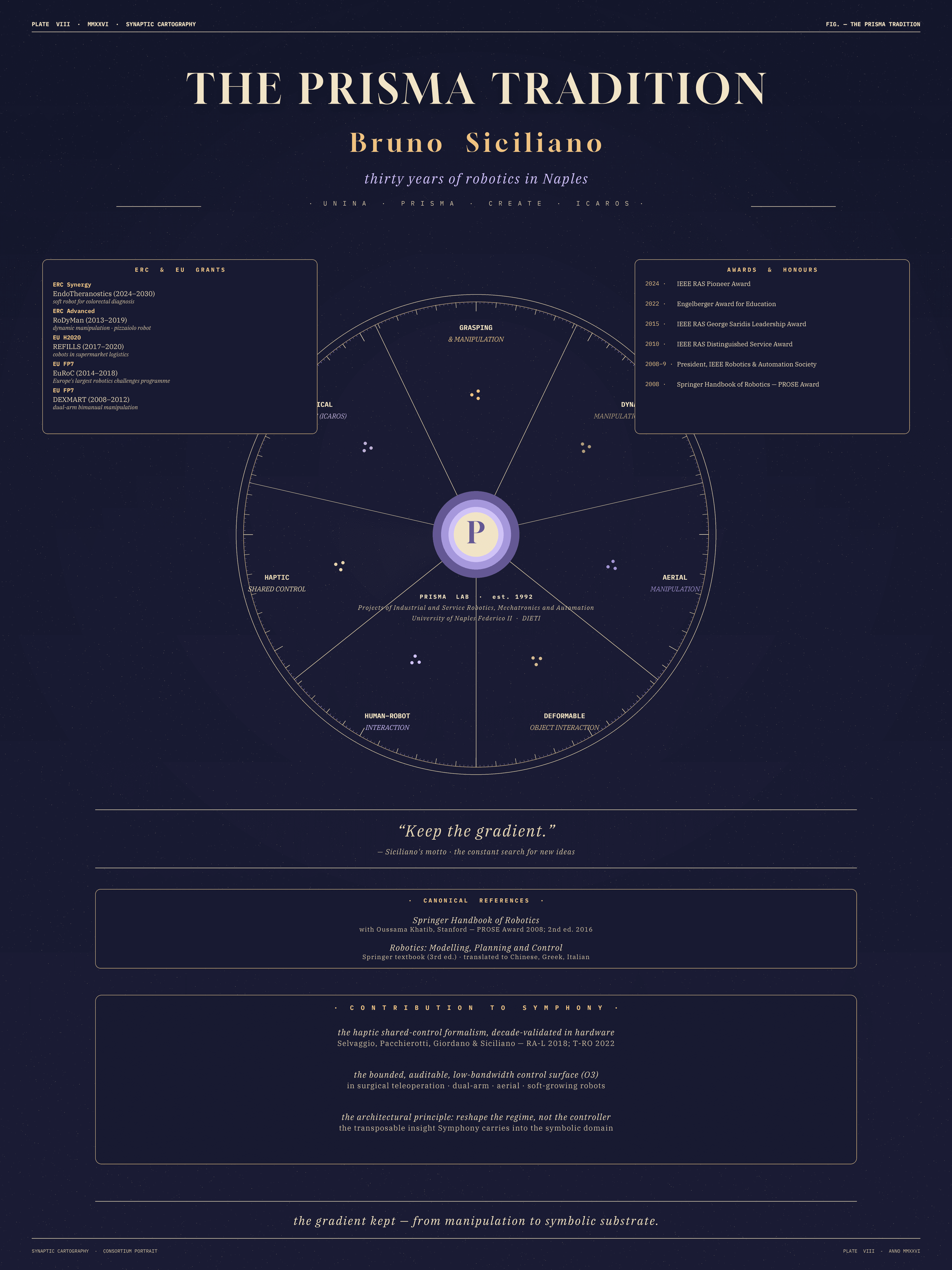
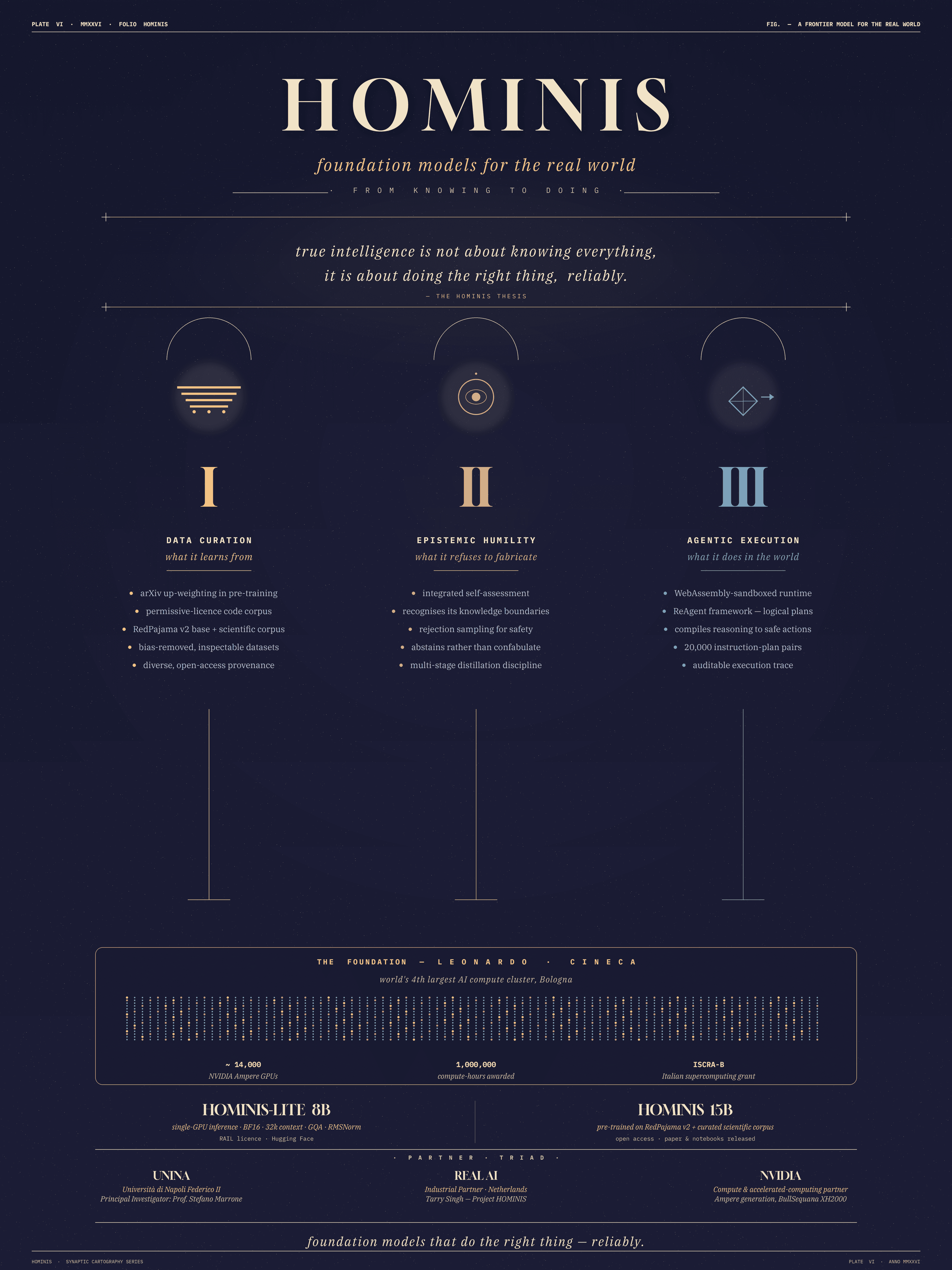
Plate VI · Hominis cathedral
Tarry Singh
Founder of Real AI. Three decades across data and AI delivery at industrial scale, with a current focus on foundation models for the real world: Hominis, a family of situated, auditable, compute-aware foundation models trained on allocation time at Leonardo, the EuroHPC supercomputer at CINECA, Bologna.
Real AI coordinates SYMPHONY end-to-end and leads O1, the four-layer extraction pipeline, and O4, the pre-registered benchmark against frontier LLM and knowledge-graph baselines.
Read Tarry Singh’s full page →The fourth partner
UP Robotics contributes the industrial-automation demonstrator codebase. The O1 pipeline that builds the substrate and the O4 benchmark that validates it must both survive contact with this code, a production system whose maintenance logs supply half of the held-out task instances. Without a real industrial system in the loop, SYMPHONY is a paper claim.
Read UP Robotics’ full page →Whether multi-scale neuromodulation, demonstrated in continuous perceptual and motor domains characterised by embodied feedback, transfers to a symbolic and structural domain (source code) where the signals are discrete, hierarchical, and linguistic. This is not a question of engineering polish; it is a question of whether the biological principle generalises.
The five objectives above are constructed so that their decision milestones surface a clear answer within the project’s 36 months, not by retreat to a less ambitious aim, but by forcing the question into a measurable outcome.
More plates are coming.
Each one takes its time. Leave an address and you'll be first through the door when the next plate opens, what I'm building, what I'm reading. Quiet, infrequent, never a funnel.
Plates from a studio that takes its time.